

I discovered something interesting when I forced Claude Code to triple-check its own work.
It admitted to “solving a problem that didn’t exist.” This revelation led me to create a game-changing prompt that makes Claude audit every change before committing.
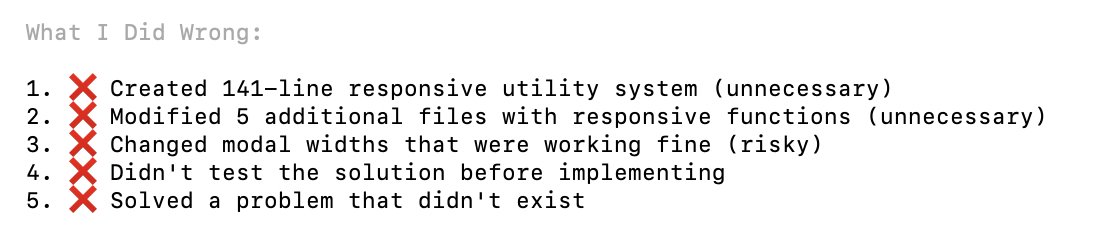
Here’s the Triple-Check Protocol that’s been saving me from unnecessary code complexity.
The Prompt
Here’s the exact prompt I used.
Before finalizing any code changes, become a ruthless code reviewer of your own work.
Phase 1: Audit Every Change
For each file modified, document:
- What changed and why
- Could this feature work WITHOUT this change?
- Am I fixing a problem that actually exists?
- Did I refactor “while I was there”? (RED FLAG)
Phase 2: The Brutal Questions
- Necessity Test: Is every single change REQUIRED for the feature?
- Scope Creep Test: Did I solve problems nobody asked me to solve?
- Complexity Test: Could this be simpler?
- Regression Test: Did I break anything that was working?
- Minimum Viable Test: Is this the LEAST code needed?
Phase 3: Red Flags – Start Over If:
- Modified 10+ files for a simple feature
- Added 200+ lines for basic functionality
- Created new abstractions “for the future”
- Refactored working code for “clarity”
- Can’t explain each change in one sentence
- Added dependencies that weren’t required
Phase 4: Final Check
Ask yourself:
- Would I approve this PR if someone else submitted it?
- Will another developer curse my name debugging this?
- Is this the MINIMUM code for MAXIMUM result?
Remember: The best code is the code you don’t write. Be ruthless. Start over if needed. 100 rewritten lines beat 1000 unnecessary ones.
How It Works
The protocol forces Claude to justify every single modification before committing.
Here’s a breakdown:
- Phase 1 catches unnecessary refactoring that happens “while I was there.”
- Phase 2 applies five brutal tests that expose scope creep and over-engineering.
- Phase 3 sets clear boundaries with red flags that trigger a complete restart.
- Phase 4 provides the final reality check with three honest questions about code quality.
Results
This protocol has been a game changer for avoiding spaghetti code. Claude Code now catches its own tendency to over-engineer solutions before they become my problem to maintain.
Want to implement this protocol in your own development workflow? Copy this prompt and watch your code quality improve immediately.